

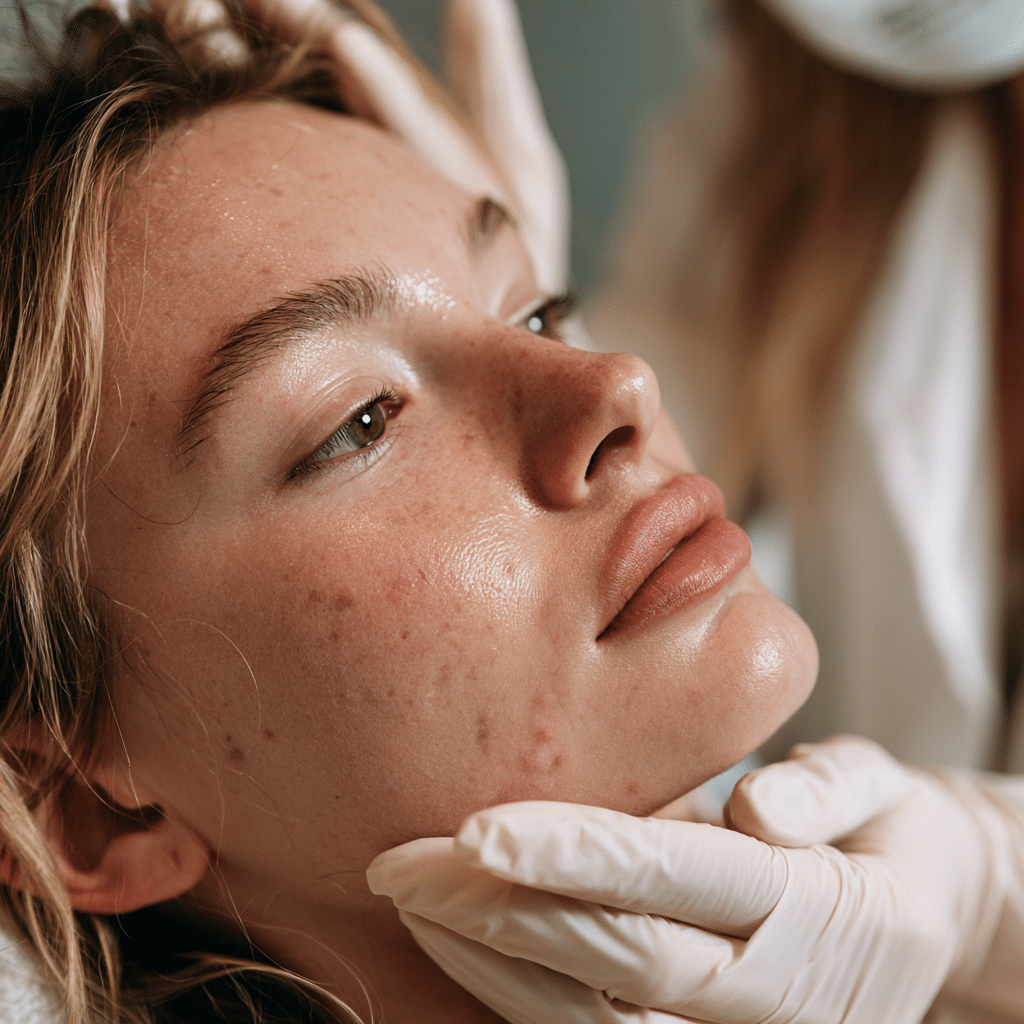
Your acne finally cleared up – but the marks it left behind didn’t get the memo. If you’re staring in the mirror at pitted skin or stubborn red marks and wondering why your skincare routine isn’t touching them, here’s the honest answer: acne scars usually need more than good products. They need a plan built around the specific type of scarring you have. Here’s how board-certified dermatologists actually approach it.
Not All Acne Scars Are the Same (and That’s Why Treatment Isn’t One-Size-Fits-All)
Before anyone reaches for a laser or a needle, a dermatologist needs to answer one question: what kind of scar is this? Most acne scars fall into one of two big buckets:
- Atrophic scars – these are the indented ones, and they’re by far the most common. Dermatologists break them down further into three shapes: ice pick (small, deep, narrow), boxcar (wider with defined edges), and rolling (shallow, wavy dips).
- Hypertrophic or keloid scars – these are raised instead of indented, and they’re treated completely differently, with injections rather than resurfacing.
One more thing worth knowing: if you still have active breakouts, treating scars is usually put on hold until acne is under control. New inflammation can undo the progress and even create new scars, so calming the acne itself always comes first.
The Main Treatment Options, Explained Simply
Lasers – the Workhorse
- Stronger (“ablative”) lasers go deeper. Best for more significant scarring.
- Gentler lasers are often better for lighter scarring or deeper skin tones, since strong lasers carry more risk of leaving dark marks behind.
- A separate type of laser can target lingering redness around a scar.
Microneedling – the Gentle Rebuilder
- Tiny needles create controlled micro-injuries that prompt your skin to rebuild collagen.
- One of the more comfortable, lower-downtime options.
- Often the safer starting point if you have a darker skin tone and want to minimize pigment risk.
Chemical Peels – for Surface Texture
- Work on the surface layer — great for smoothing texture and fading discoloration.
- For ice pick scars specifically, dermatologists use a targeted technique called CROSS: a strong peel solution applied precisely into each tiny scar, rather than across the whole face.
Subcision – Releasing “Tethered” Scars
- Sounds intense, but it’s simple: a thin needle releases the scar tissue pulling a rolling scar downward, letting the skin sit flatter.
- Often used as a first step before laser or filler is added on top.
Filler – for a Fast, Visible Lift
- Physically lifts a depressed scar, with results you can see almost right away.
- The trade-off: most fillers fade over months, so it’s maintenance, not a permanent fix.
PRP (Platelet-Rich Plasma) – the Accelerant
- Rarely used alone. Think of it as a boost layered on top of laser or microneedling.
Retinoids – the Supporting Player
- Your at-home retinol or prescription retinoid won’t erase deep scarring.
- Can offer modest texture improvement and help prevent things from getting worse.
Rejuran / PDRN – the Newer Regenerative Option
- A brand-name injectable made from PDRN, a substance derived from salmon DNA that’s long been used in wound healing.
- Calms inflammation and encourages your skin to build its own collagen, rather than resurfacing or lifting the skin directly.
- Early studies on scar and burn patients show improved texture and less visible scarring; it’s sometimes paired with PRP or other treatments.
- Still newer than lasers or microneedling, with a smaller research base – think of it as a promising add-on for now, not yet a proven stand-alone fix.
For Raised (Hypertrophic or Keloid) Scars, the Approach Flips
Instead of resurfacing, the go-to first treatment is a steroid injection directly into the scar – sometimes paired with another medication injection, laser, or silicone gel.
So… What Actually Works Best?
Here’s the good news: dermatology researchers have actually studied this question directly, pooling results from 68 clinical trials and over 4,400 patients. The takeaway was clear – combining treatments beats using just one.
Specifically, laser paired with PRP came out on top for reducing overall scar severity. Laser paired with filler ranked best on a separate scarring scale. And when it came to how happy patients actually were with their results, laser combined with a chemical peel won out. Microneedling, meanwhile, was the most comfortable option if pain tolerance is a big factor for you. Interestingly, no single treatment was clearly safer than the others when it came to leaving temporary redness or dark marks behind – so your dermatologist choosing the right settings for your specific skin tone matters just as much as which treatment you pick.
To put real numbers to it: one study compared laser to microneedling side-by-side on the same patients’ faces over four months. The laser side improved about 33% on a standard scarring scale (and patients rated their own improvement even higher, around 49%), compared to roughly 9% and 20% on the microneedling side. Laser pulled ahead especially for rolling and boxcar scars – though it also came with more temporary dark marks afterward, especially in deeper skin tones. Ice pick scars were the toughest customers for both treatments, which is exactly why they usually get the targeted CROSS technique instead.
Why You’ll Probably Need More Than One Treatment
Most people don’t have just one type of scar – you might have a few rolling scars, a couple of boxcar scars, and some lingering discoloration, all at once. That’s why dermatologists usually build a staged plan rather than betting everything on one treatment: maybe subcision first to release tethered scars, then a few rounds of laser or microneedling for texture, with peels or PRP layered in along the way. It takes patience, but it’s how the best results actually happen.
Can Skincare Products Help?
At-home retinoids, vitamin C, and gentle acids are genuinely useful – just not as a stand-alone fix. Think of them as support for your in-office treatments: they help maintain results and fade lingering discoloration, but they can’t rebuild the collagen loss that causes true pitted scarring.
What Kind of Results Should You Actually Expect?
Real talk: the goal is meaningful improvement, not a total do-over. Most patients see genuine, visible change – but scars that took months or years to form usually take a series of treatments, not a single visit, to improve. That’s normal, not a sign something’s not working.
The Bottom Line
Getting your acne scars actually diagnosed – not just treated – is the real first step. From there, the evidence points pretty clearly toward combining treatments: laser with PRP, filler, or peels, spaced out and sequenced for your specific scars, rather than pinning your hopes on any single treatment.
This article is for general educational purposes and isn’t a substitute for a one-on-one evaluation. If you’re dealing with persistent adult acne, a dermatology consultation can help identify what’s actually driving it and build a plan around your skin specifically.