
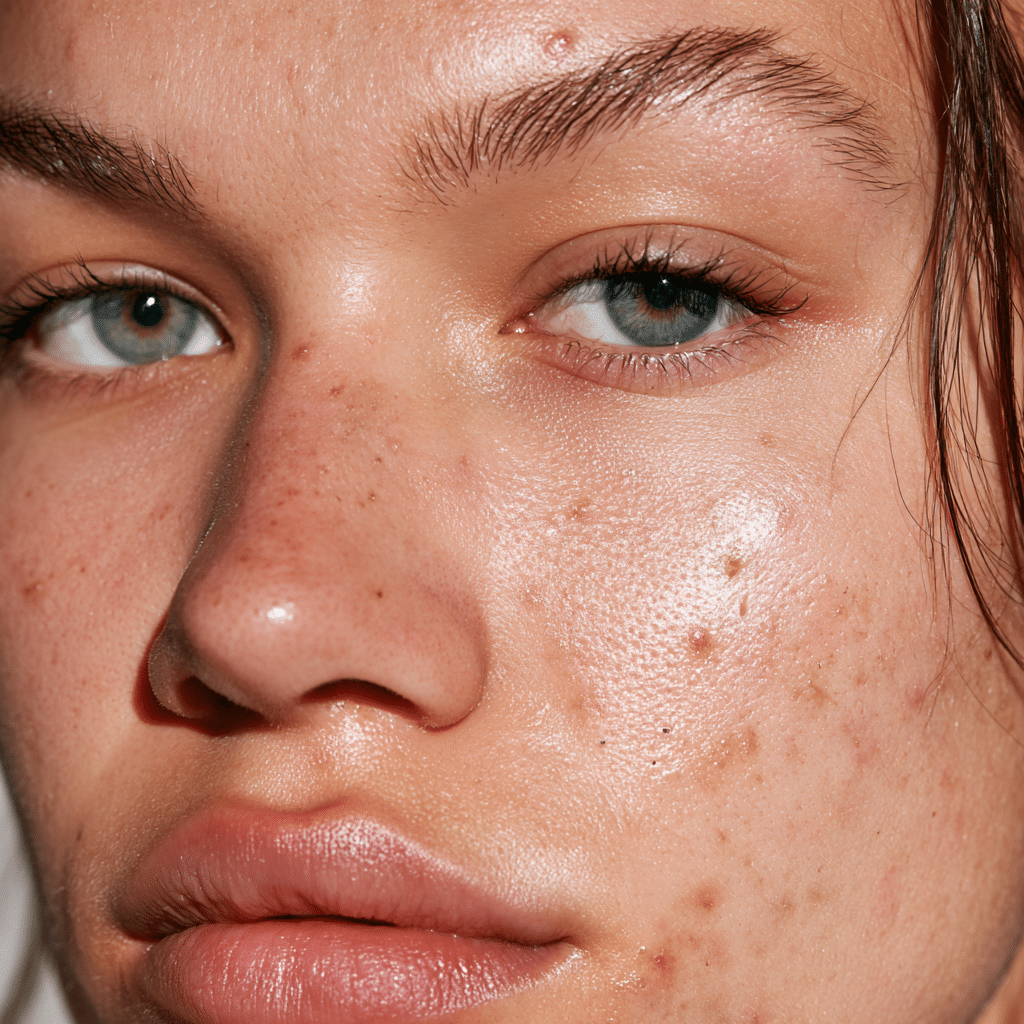
You did your time in high school. You dealt with the breakouts, survived the awkward yearbook photos, and figured that chapter was closed. So why, at 28, 34, or 42, are you suddenly staring at a new pimple on your chin the night before a big meeting?
Here’s the reassuring part: this isn’t random, and it’s not because you’re doing something wrong. Your skin’s oil glands stay hormonally “switched on” for your entire adult life – not just during puberty. So the same basic ingredients behind teenage acne (extra oil, clogged pores, bacteria, inflammation) are still very much active decades later.
You’re in Very Good Company
If it feels like everyone around you has “grown out of” acne except you, the data says otherwise. In one well-known study of over 1,000 adults, roughly half of women and over 40% of men in their 20s said they still dealt with breakouts – and about a third of women and a fifth of men still did in their 30s. Other research puts adult acne somewhere between 40% and 55% of women in their 20s and 30s, depending on how it’s measured. Translation: adult acne isn’t the exception. It’s closer to the norm.
What Causes Adult Acne? 5 Common Triggers
There’s rarely just one cause behind adult acne. Usually it’s some combination of the following:
1. Hormones Are Still Calling the Shots
Breakouts that show up in adulthood tend to fall into one of three patterns: acne that never really left since your teens, acne that shows up brand new as an adult, or acne that clears for a while and then comes back. All three are common, and figuring out which one is yours actually helps guide treatment.
2. PCOS or Another Hormonal Condition Could Be Involved
If your acne is stubborn, cystic, and shows up alongside irregular periods, extra hair growth, thinning hair, or darker patches of skin in body folds, it’s worth mentioning to your board-certified dermatologist. Polycystic ovary syndrome (PCOS) is a common, often under-recognized driver of persistent adult acne – and sometimes the skin is what tips someone off before anything else is diagnosed.
3. A Medication or Supplement Might Be the Culprit
Certain medications – steroids, some antibiotics, lithium, anti-seizure medications, testosterone therapy, and a few others — can trigger breakouts weeks or months after you start taking them. Even whey protein powder has been linked to chest and back breakouts in some people. If your skin changed around the same time as a new prescription or supplement, that’s worth flagging.
4. Your Skincare or Makeup Could Be Working Against You
Pore-clogging products are a genuinely common, easy-to-miss cause of new breakouts, especially if you recently switched up your routine.
5. Stress and Smoking Don’t Help
Both are documented acne triggers, which let’s be honest, makes New York City basically an acne trigger with a skyline.
Wait, Is It Even Acne?
Here’s a twist a lot of people don’t expect: some things that look exactly like acne aren’t acne at all. If you’re not seeing actual blackheads or whiteheads, it might be:
- Rosacea – persistent redness and flushing across the center of your face
- Perioral dermatitis – small bumps clustered around your mouth, nose, or eyes
- Folliculitis – itchy, uniform bumps, often on the chest or back
- A medication reaction – bumps that look similar to acne but showed up after starting something new
This matters because treating the wrong thing with acne products can sometimes make these conditions worse.
When Is It Worth Getting Bloodwork?
Most adult acne can be diagnosed just by looking at it – no labs required. But if your breakouts are severe, resistant to everything you’ve tried, came on suddenly, or you’re also noticing irregular periods or unexpected hair growth, your dermatologist may suggest hormone testing to check for something like PCOS underneath it all. And if severe acne shows up very suddenly alongside rapid, dramatic changes in your body, that’s a signal to get checked out promptly, since – rarely, it can point to something more.
Where It Tends to Show Up (and Why That’s a Clue)
Notice your breakouts clustering around your jawline and chin rather than your forehead? That’s a classic sign hormones are involved. Adult acne also tends to run deeper and more cyst-like than the surface-level bumps you probably remember from your teens – which is exactly why your old teenage go-to products might not be cutting it anymore.
Please Don’t Declare War on Your Skin
It’s tempting to fight adult acne the way you fought it at 16 – the harshest wash, the strongest retinoid, used every single day. Resist that urge. Adult skin tends to be more sensitive and have a thinner protective barrier than it did back then, so going scorched-earth on it often backfires, triggering even more oil and more breakouts. The better move treats your skin barrier and your acne at the same time, instead of treating your face like a battlefield.
How a Dermatologist Actually Approaches This
At L’AVENUE Derm, figuring out your adult acne starts with the full picture, not just the pimples themselves – your hormonal patterns, your current routine, your stress and sleep, and what you’ve already tried (so you’re not repeating something that didn’t work the first time). From there, your plan might combine prescription treatment, in-office options like customized peels or laser, and some practical lifestyle guidance – built around you, not a generic product list.
When to Stop Waiting It Out
If you’ve stuck with a gentle, consistent routine for a few months and nothing’s improving – or your breakouts are painful, cystic, or coming with other symptoms like irregular cycles – it’s time to bring in a professional rather than trying yet another serum. The sooner persistent acne gets addressed, the better your odds of avoiding scarring or lingering dark marks down the line.
The Bottom Line
Adult acne in NYC is common, explainable, and very treatable – you don’t need to just live with it. The real unlock is ditching the generic “acne skincare” approach in favor of a plan built around your actual hormones, habits, and skin, with an eye toward ruling out anything else that might be masquerading as acne.
This article is for general educational purposes and isn’t a substitute for a one-on-one evaluation. If you’re dealing with persistent adult acne, a dermatology consultation can help identify what’s actually driving it and build a plan around your skin specifically.